



-30046101.jpg)
Pinnacle pins Scottie Scheffler as the golfer to back in their PGA Championship Winner Betting Market
30 Apr 2024
Цааш унших
How much value is there in soccer betting markets?
- Find out how to find value in soccer betting markets
- Learn about expected value
- Find out how to calculate expected value
- Get the best stats to use to help you find value

When you come to trying to be a successful soccer bettor, you simply have to take expected value into account. This is a hugely important facet of betting on soccer that many punters ignore. With that being said, how can you find value in soccer betting markets? Read out guide o finding the value when betting on soccer below.
How do I analyse odds using Expected Value?
Expected value can be simply explained by the following equation:
Expected Value = (Bookmaker's Odds/True Odds) -1
If the true odds are $2.00 and the bookie is offering odds of $2.10, this means the expected value (EV) is 0.05, or 5%. If the true odds are $4.00 and the bookie's odds are $3.50, the expected value is -0.125, or -12.5%.
Experienced bettors are only interested if the expected value is greater than 0%, or when the bookie offers odds that are longer than the true odds.
Knowing what the true odds are is another matter altogether, and this is why this is an area of betting that is completely missed by newer bettors or those that only casually bet.
Sports betting is not like dice games and the markets are complex systems, for which there are no simple algorithms that will tell you what the true outcome probabilities are. You have to estimate them via data modelling along with a lot of intuition as well. The better your model, the closer your estimated probabilities will be to the true probabilities.
Our model is a combination of data analysis and the market information that is acquired about customers’ models, meaning it’s one of the best at estimating true probabilities. Of course, this does not mean that it will nail the outcome every single time, but it is surprisingly good.
Individually, it’s impossible to know which odds were closer to the true odds and which were not so close, but on average, the errors are broadly cancelled out.
How do I apply Expected Value to soccer markets?
The closing odds before a match starts actually tell us more information about the match than the odds. On average, the closing odds tend to be far closer to the true odds than the original ones.
You can assume that the more the odds move, the more expected value there was available in the original odds. Of course, it would be foolish to assume the closing odds are always correct. This works the other way too when regarding the initial odds as always incorrect.
Instead, this means that the ratio of the two can be used as a proxy measure of Expected Value, given that we can’t know what the true odds are. This can be formulated as follows:
Expected Value = (First Odds/Last Odds) -1
It can happen where both the initial odds and the closing odds will be shorter than the true odds. Sometimes they’ll both be longer, while other times the initial odds will be longer than the true odds and the closing shorter, and sometimes the opposite will happen too.
On average, the ratio of the two should give you a good idea of how much expected value actually existed in the initial odds.
With this in mind, how much expected value actually exists in soccer betting markets? For a sample of 158,092 soccer matches and 474,276 home-draw-away betting odds, we divided Pinnacle’s initial odds by their closing odds, having removed their margin from the closing odds, and subtracted one.
So, how many odds had Expected Value greater than 0%? The figure was 29.7%. That’s actually quite a surprise. This simple means nearly a third of Pinnacle’s initial odds hold some Expected Value.
How meaningful is Expected Value in soccer betting markets?
You might expect there to be more occurrences of low Expected Value (e.g. 2%) than high Expected Value (e.g. 20%). But how much more will there actually be? We ranked the size of the expected value for each bet in ascending order, then calculated a cumulative percentage.
For example, 29.7% of odds held EV greater than 0%, but this falls to 21.7% for EV greater than 2%. By the time we reach the threshold of 10%, only 6.6% of odds will hold such value on average, and at 20% it’s just 1.8%. This is how such a trend appears on a graph:
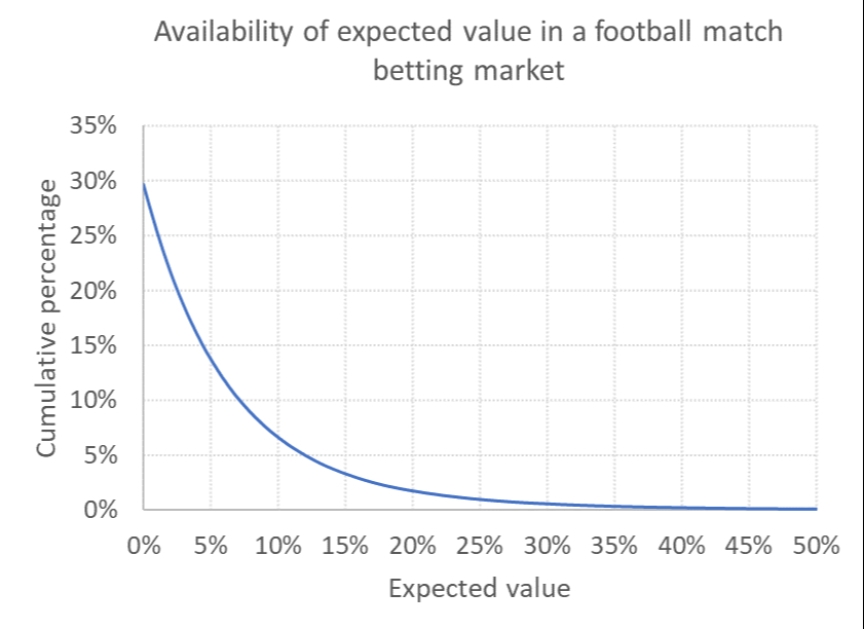
Clearly, there is a lot of expected value to be found in the soccer match betting market. However, you cannot expect it to be massively easy to find. The availability of increasing EV falls massively, which means the greater the expected value, the far less of it you will find, and that is assuming you even know where to find it.
The biggest problem for bettors is knowing the expected value is there in the first place. Using this measure, you won’t know that it was there until Pinnacle have published their closing odds and by then, the initial odds have gone.
Regardless, if you do have a forecast model that works and can estimate the true odds, you now know that when Pinnacle publish their initial odds, there is some potential for making a profit.
Хамгийн сүүлийн үеийн мэдээ
-
 PGA Championship
 -
Premier LeaguePremier League Predictions - Get the best betting tips & predictions for Matchday 3 in the Premier League12 Apr 2024 Цааш унших
-
NFLIn-play NFL betting strategy12 Dec 2023 Цааш унших
-
La LigaLa Liga Predictions For Matchday 3 - Get the latest tips for the biggest La Liga games including Villarreal vs Barcelona25 Aug 2023 Цааш унших
-
La LigaLa Liga Predictions For The Final Day31 May 2023 Цааш унших